

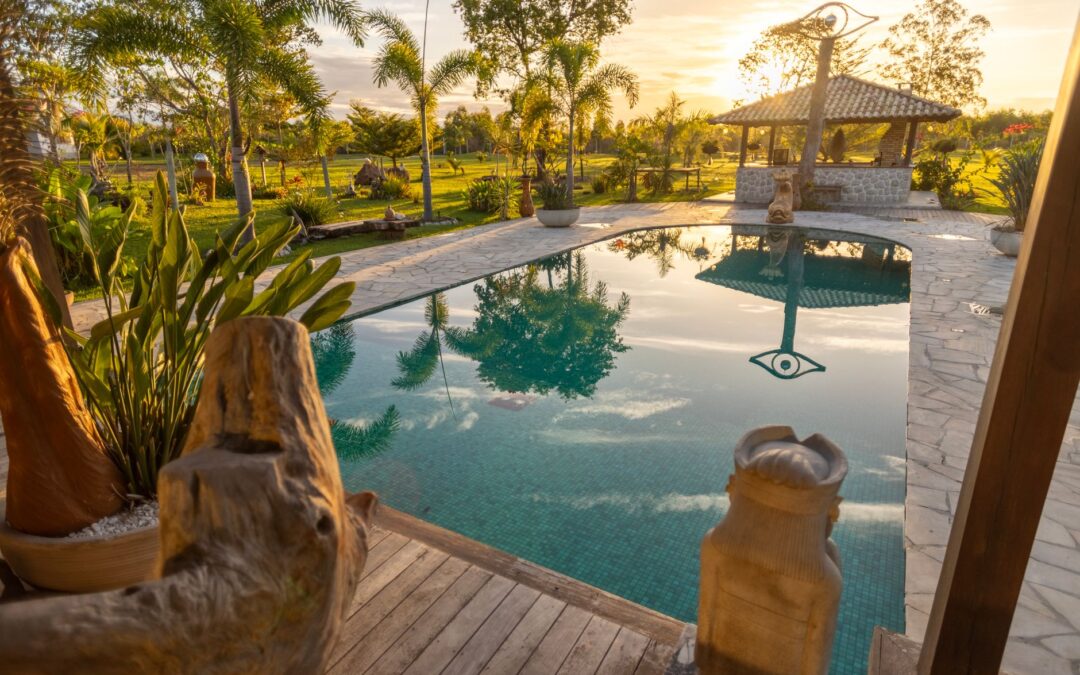
Good pool landscaping starts with three non-negotiables: keep the pool clean, keep the surroundings safe, and keep maintenance low. That means non-shedding, root-safe plants set back at least 3–4 feet from the coping, slip-resistant hardscape, and drainage that pulls runoff away from the water. Get those right and everything else — lighting, privacy, color — becomes styling. Below is the full framework for designing the space around a swimming pool, plus real cost ranges and the specific plant and material choices that survive South Louisiana’s heat and humidity.
What is the best pool landscaping layout?
The best pool landscaping layout works in concentric zones. Zone one is the pool deck itself — a 4-to-8-foot band of hardscape that must be slip-resistant and stay cool underfoot. Zone two is the planting border, set back 3–4 feet so leaves and roots don’t reach the water. Zone three is the privacy and backdrop layer of taller shrubs, ornamental trees, or fencing.
Working in zones prevents the most common mistake: plants dumped right at the water’s edge that shed debris into the pool and heave the coping with their roots. It also gives you circulation space for chairs, a grill, or a walkway.
Orient the layout around how you actually use the pool. A sunbathing family wants open deck on the south side; a household that wants shade wants a pergola or trees to the west to block afternoon glare. Sketch the sun path before you plant anything — the University of Illinois Extension notes that a plant’s sun and shade needs drive placement more than looks do.
Which plants are best for pool landscaping?
The best plants for pool landscaping are evergreen, non-fruiting, non-thorny, and root-friendly. You want minimal litter, no messy berries, and roots that won’t crack the deck.
Reliable choices for South Louisiana
- Ornamental grasses (muhly grass, dwarf fountain grass) — soft texture, almost no litter, thrive in heat.
- Dwarf palms and sagos — that resort feel without dropping seeds into the water; keep sago away from pets as the seeds are toxic.
- Agapanthus, daylilies, society garlic — color at the border with tidy foliage.
- Boxwood, dwarf yaupon, Indian hawthorn — evergreen structure and screening.
Plants to avoid
Skip anything that sheds heavily or invites bees near swimmers: bald cypress, live oak (acorns), bottlebrush and dense flowering shrubs at the deck edge, and bougainvillea (thorns). The Louisiana State University AgCenter publishes climate-appropriate plant lists worth checking before you buy.
What hardscape materials work best around a pool?
The best pool decking is slip-resistant, stays cool, and tolerates chlorine and salt. Top performers are travertine, tumbled concrete pavers, and textured broom-finish concrete. Travertine stays noticeably cooler than dark stone and grips well when wet, which is why it dominates high-end pool landscaping projects.
Cost ranges (installed, per square foot)
- Broom-finish concrete: $8–$15
- Concrete pavers: $15–$30
- Travertine: $20–$40
- Natural flagstone: $25–$50
Avoid smooth, dark, or polished surfaces — they get scorching in Acadiana summers and turn slick when splashed. Coordinate the deck color with the house and coping so the whole space reads as one design rather than a slab bolted onto a backyard. Wide-joint sand or polymeric joints let water drain rather than pooling on the surface.
How do you handle drainage and runoff around a pool?
Drainage is the part of pool landscaping most homeowners skip and most regret. Water must move away from both the pool and the house. Grade the deck to slope 1–2% (about a quarter-inch per foot) toward channel drains or a French drain that carries overflow to a lawn area or dry well.
In South Louisiana’s clay soils and heavy rain, poor drainage causes settling decks, cracked coping, and standing water that breeds mosquitoes. A deck drain along the low edge, paired with subsurface piping, keeps splash-out and storm runoff from undermining the structure. The EPA’s guidance on managing stormwater explains why directing runoff to permeable areas beats letting it sheet across pavement. Plan drainage before pouring hardscape — retrofitting it later means cutting concrete.
How much does pool landscaping cost?
A complete pool landscaping project in the Lafayette area typically runs $8,000 to $40,000+, depending on scope. Planting-only refreshes start around $3,000; full design-build surrounds with deck, drainage, lighting, and mature plantings reach $50,000 or more.
Rough budget breakdown
- Planting and beds: $2,500–$8,000
- Deck / hardscape: $6,000–$25,000
- Drainage system: $1,500–$6,000
- Landscape lighting: $2,000–$6,000
- Privacy screening / pergola: $3,000–$15,000
The biggest cost drivers are hardscape square footage, material grade, and how much grading and drainage the site needs. Buying mature plants for instant impact also raises the total. A phased plan — structure and drainage first, then plantings, then lighting — lets you spread cost over seasons without redoing work.
How do you make pool landscaping low-maintenance?
Low-maintenance pool landscaping comes from smart plant selection and drip irrigation, not from having fewer plants. Choose evergreens that don’t shed, mulch beds to suppress weeds, and install drip lines so water reaches roots instead of splashing chemicals onto foliage or diluting your pool chemistry.
Keep beds set back so a leaf blower can clear the deck in minutes. Group plants by water need so the whole bed runs on one zone. Hardscape more of the immediate perimeter to cut mowing and edging right at the water. An automatic irrigation controller with a rain sensor handles watering while you’re away — critical during Louisiana’s swing between drought and downpour. A pool cover further reduces debris load from any nearby plantings and slashes evaporation and chemical loss.
What about pool lighting and privacy?
Lighting and privacy turn a daytime pool into a nighttime destination. Low-voltage LED path and uplighting along the deck edge improves safety and highlights specimen plants and water features. Aim for warm 2700K–3000K light and avoid glare across the water’s surface.
Privacy options ranked by cost
- Evergreen hedge (wax myrtle, cleyera): most affordable, takes 2–3 seasons to fill in.
- Lattice or slat fencing with vines: fast screening, mid-range cost.
- Pergola or cabana: highest cost, adds shade and architecture.
Combine layers — a hedge for the long view and a pergola for the lounging zone — rather than relying on a single tall fence that feels like a wall. Position screening to block sightlines from neighbors and the street, not to box the pool in.
Why do national sites rank for this, and what does a local pro do better?
National sites like Houzz and directory-style pages rank for pool landscaping because they publish huge photo galleries and broad idea lists. What they can’t do is design for your soil, your drainage, and your climate. A Louisiana pool doesn’t behave like an Arizona one — clay soil, 90% summer humidity, hurricane-season rainfall, and salt-chlorine exposure all change which plants and materials actually survive.
A local design-build firm walks the site, checks how water moves, tests the soil, and specifies plants proven in Acadiana. It coordinates the deck, drainage, irrigation, and lighting as one system so nothing gets retrofitted or torn out later. EdenScapes is one Lafayette-based firm that designs, builds, and maintains pool surrounds under a single integrated contract, matching plant and hardscape choices to South Louisiana conditions. Hiring locally also means one accountable team for warranty and seasonal upkeep, rather than piecing together a contractor, a nursery, and a maintenance service that never talk to each other.
What are the steps to plan a pool landscape project?
A good pool landscaping project follows a clear sequence so you never pay to redo finished work.
The design-build sequence
1. Assess the site — sun path, soil, existing drainage, sightlines, and how you’ll use the space.
2. Set the layout in zones — deck, planting border, and backdrop.
3. Solve drainage and grading before any hardscape is poured.
4. Install hardscape — deck, coping, walkways, and any structures.
5. Run irrigation — drip to beds, separate zones by water need.
6. Plant — structure shrubs first, then color and groundcover.
7. Add lighting and finishing — fixtures, mulch, and accents.
Build in a maintenance plan from day one: who prunes, adjusts irrigation, and refreshes mulch each season. Getting the sequence right is the difference between a pool surround that looks great for a decade and one that needs rework in two years.