

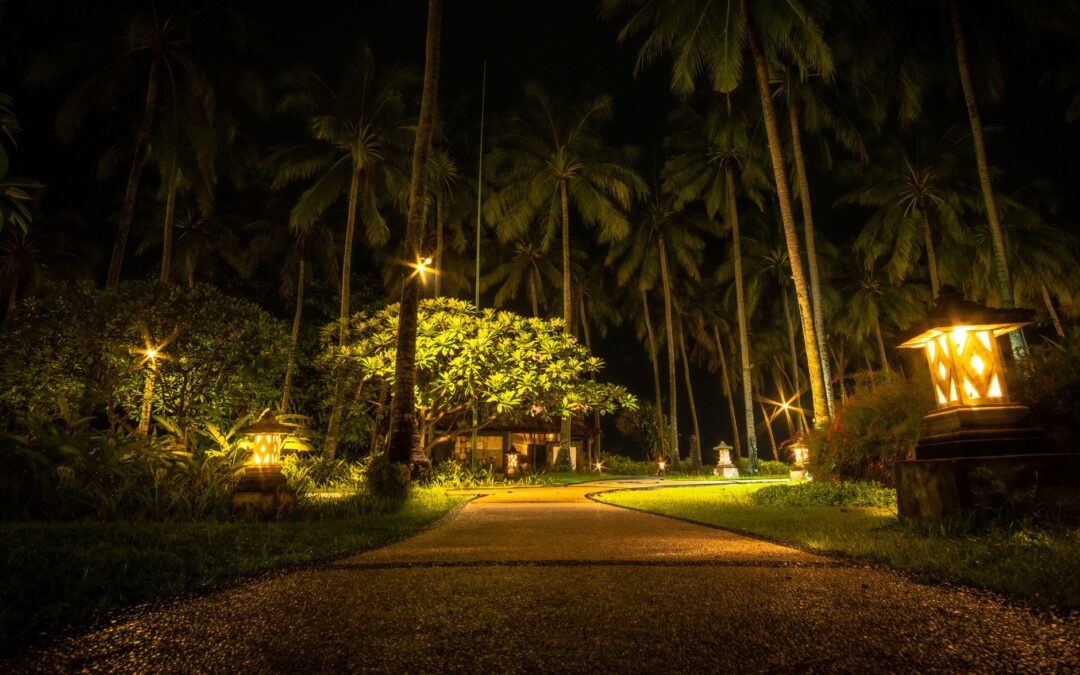
A well-designed led landscape lights system costs roughly $2,500 to $6,000 installed for an average Lafayette home, uses up to 80% less energy than halogen, and delivers 40,000–50,000 hours of life — about 20 years at nightly use. That combination of low running cost, long lifespan, and heat resistance is why LED has become the default choice for outdoor lighting across Acadiana. Below is the practical, number-first guide to planning a system that survives South Louisiana humidity, storms, and salt air.
What are LED landscape lights and how do they work?
LED landscape lights are low-voltage outdoor fixtures that use light-emitting diodes instead of incandescent or halogen bulbs. A transformer steps household 120V power down to a safe 12V, which runs through buried cable to each fixture. Because LEDs convert most of their energy into light rather than heat, a 4-watt LED can replace a 20-watt halogen and produce the same brightness.
The core components are the same regardless of brand: a transformer sized to total wattage plus 20% headroom, direct-burial low-voltage cable, and fixtures such as path lights, spotlights, well lights, and downlights. Most quality LED systems today are integrated — the diode is built into the fixture and rated for tens of thousands of hours — rather than using replaceable bulbs.
For a deeper technical breakdown, the U.S. Department of Energy’s guide to LED lighting explains efficiency and lifespan ratings. In practical terms for a homeowner: LED means less heat, lower bills, fewer bulb changes, and fixtures that hold up far better to Louisiana’s punishing summer temperatures.
How much do LED landscape lights cost to install?
A professionally installed LED landscape lights system in the Lafayette area typically runs $2,500 to $6,000, though larger estates with lighting for architecture, trees, and hardscapes can exceed $10,000. Cost depends on fixture count, transformer size, cable runs, and design complexity.
Typical price breakdown
- Fixtures: $80–$250 each installed for quality brass or copper units; cheaper cast-aluminum runs less but corrodes faster.
- Transformer: $200–$500 depending on wattage and whether it includes photocell and timer controls.
- Low-voltage cable and connectors: $1–$3 per foot installed.
- Design and labor: often 40–50% of the total on a professional job.
DIY kits from big-box stores start around $150 for a handful of path lights, but they use thinner cable and lower-grade fixtures that fade or fail within a few seasons. According to This Old House, the difference between a $30 fixture and a $150 fixture is usually the housing metal and the quality of the LED driver — and that determines whether your system lasts 3 years or 20.
Why do competitors rank for LED landscape lights — and what should you actually compare?
Several Acadiana landscapers rank for LED landscape lights because they publish deep, service-specific pages describing design, fixtures, and warranty. What matters more than who ranks is whether the installer offers three things: a photometric plan, corrosion-rated fixtures, and integrated maintenance.
What separates a lasting install from a cheap one
- A real lighting design, not just fixtures spaced along a walk. Good design layers uplighting, downlighting (moonlighting), and path lighting to create depth rather than a runway.
- Brass or copper fixtures with a lifetime finish, chosen because they patina rather than corrode in humid, salt-tinged air.
- Design-build-maintain under one contract, so the same team that engineered your drainage and hardscapes also routes cable and services fixtures.
Many firms sell fixtures; fewer integrate lighting into a whole outdoor plan. When your lighting contractor also built your patio and irrigation, cable conflicts and re-digging get avoided entirely. That integration — not a lower fixture price — is what protects your investment over 20 years.
What types of LED landscape lights should I choose?
Choose fixture types by the job each one does, not by what’s on sale. A balanced yard usually combines four or five fixture styles to create layered, professional-looking light rather than scattered bright spots.
Common fixture types
- Path lights — illuminate walkways and garden beds with a soft downward glow; space 6–8 feet apart.
- Spotlights / uplights — graze walls, columns, and specimen trees for drama.
- Well lights — flush, in-ground uplights that hide the source and light large trees or facades.
- Downlights (moonlighting) — mounted high in trees to cast dappled light like natural moonlight.
- Hardscape lights — thin strips tucked under caps of retaining walls and steps for safety and definition.
Color temperature matters as much as fixture choice. For residential landscapes, 2700K–3000K (warm white) flatters plantings and brick; cooler 4000K reads industrial. Stick to one temperature across the whole system so the yard reads cohesively at night.
What is the best color temperature and brightness for landscape lighting?
The best color temperature for LED landscape lights in a residential setting is 2700K to 3000K — a warm white that makes brick, stone, and foliage look natural rather than blue or clinical. Brightness is measured in lumens, and outdoor landscape fixtures rarely need to be bright.
A path light of 80–150 lumens is plenty; a tree uplight might run 200–400 lumens depending on canopy height. Over-lighting is the most common mistake homeowners make — the goal is contrast and mood, not floodlighting. The dark areas between fixtures are what give a night landscape its depth.
Dimmable and adjustable-color-temperature LED systems now let you fine-tune each zone after install, which is useful because a color that looks right on a green summer tree can look harsh against bare winter branches. If you entertain outdoors, warm dimmable fixtures around patios and seating create the most inviting effect, while slightly brighter, cooler light near steps and drives improves safety.
How long do LED landscape lights last in Louisiana’s climate?
Quality LED landscape lights last 40,000 to 50,000 hours — roughly 15 to 20 years at nightly use — but Louisiana’s heat, humidity, and storm activity make fixture material and sealing more important than the diode itself.
Humidity and salt air corrode cheap aluminum housings and oxidize poor connections within a few years. Brass and copper fixtures resist this and actually improve visually as they patina. Waterproof, gel-filled wire connectors are essential here — standard twist caps trap moisture and fail. Flood-prone yards need transformers and junctions mounted well above grade.
The Irrigation Association notes that low-voltage outdoor systems share many of the same moisture-management principles as irrigation, which is one reason integrated design-build firms handle both well. Proper burial depth, drainage-aware routing, and surge protection on the transformer all extend system life through our storm seasons far more than a premium bulb ever would.
Should I install LED landscape lights myself or hire a professional?
You can install a small DIY LED landscape lights kit in an afternoon, but a full-property system that lasts 20 years is worth professional design and installation. The dividing line is scale and permanence.
DIY makes sense when:
- You want a handful of path lights along one walkway.
- You’re comfortable with voltage drop over cable runs.
- Fixtures can be moved or replaced easily.
Hire a pro when:
- You’re lighting trees, architecture, and hardscapes together.
- Cable must route around irrigation, drainage, and patios.
- You want photocell/timer automation and a warranty.
Voltage drop is the hidden trap in DIY: run cable too far on the wrong gauge and distant fixtures dim noticeably. A professional calculates loads, splits runs, and taps the transformer at the right voltage. In Acadiana, EdenScapes installs LED landscape lighting as part of its integrated design-build-maintain service, so lighting is planned alongside the hardscapes and irrigation rather than retrofitted later — you can see their outdoor living services for how lighting fits the broader plan.
How do I maintain an LED landscape lighting system?
LED landscape lights need far less maintenance than old halogen systems, but a yearly service visit keeps them performing and protects the finish. Because there are no bulbs to change on integrated LEDs, upkeep is mostly cleaning, aiming, and connection checks.
Simple annual maintenance checklist
- Clean lenses of dirt, mud splash, and hard-water film that dim output.
- Re-aim fixtures shifted by mowing, storms, or growing plants.
- Trim foliage that has grown to block or overheat fixtures.
- Inspect connections for corrosion and reseal any exposed splices.
- Adjust the timer/photocell as daylight hours shift through the year.
Growing trees and shrubs are the biggest ongoing variable — a tree that was perfectly grazed at install can outgrow its uplight in three seasons and need repositioning. Firms offering design-build-maintain contracts fold this into scheduled visits, so the lighting evolves with the landscape instead of slowly falling out of adjustment. Left unmaintained, even premium LED systems look tired within a few years despite working fine electrically.
Are LED landscape lights worth the investment?
Yes — for most homeowners, LED landscape lights pay back in both energy savings and property value. Switching from halogen to LED can cut lighting energy use by 75–80%, and outdoor lighting consistently ranks among the higher-return exterior improvements for curb appeal and evening usability.
Beyond bills, good lighting extends how many hours you actually use your yard, improves safety on steps and drives, and adds a layer of security by removing dark hiding spots. It also showcases the hardscaping and plantings you’ve already invested in — a beautiful patio disappears after dark without it.
The caveat: cheap fixtures undermine all of this. A $150 discount kit that corrodes in three years costs more over two decades than a properly specified brass system that runs for twenty. If your yard has trees, structure, and outdoor living space worth showing off, professional LED lighting is one of the clearer-value upgrades available in Acadiana — provided it’s designed, not just installed.