

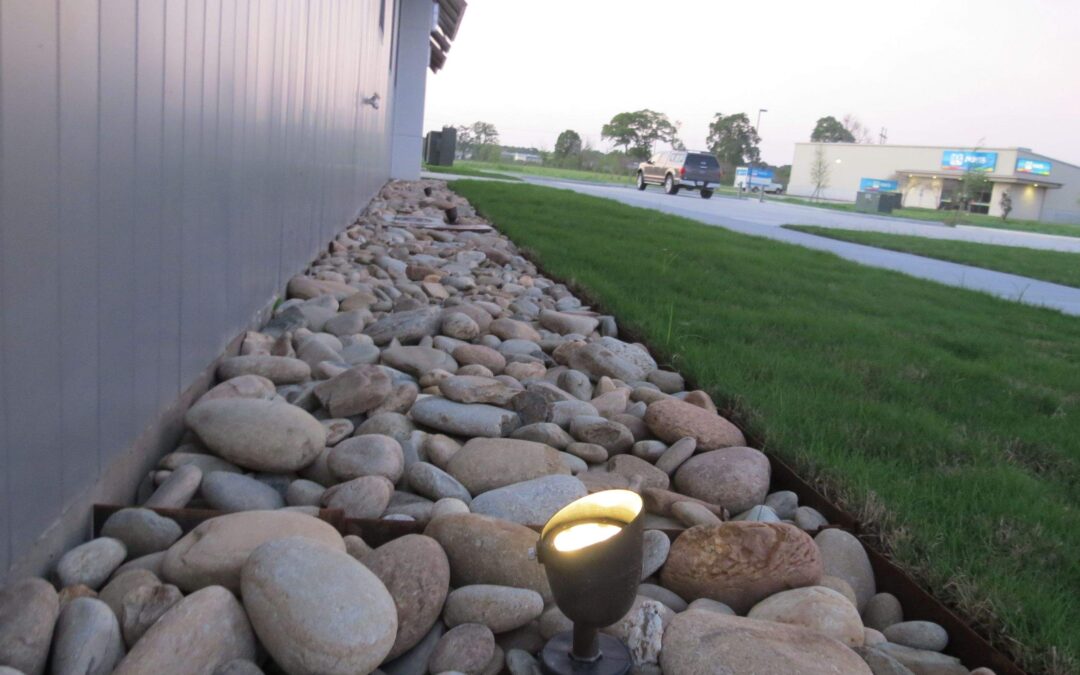
A residential landscape has to look right and hold up to a family using it. A commercial landscape has to do that plus survive foot traffic from hundreds of people a week, meet code requirements a homeowner’s yard never has to think about, and keep looking sharp with a maintenance budget that’s usually tighter, per square foot, than a residential estate’s. Those aren’t small differences — they change nearly every decision we make on a commercial site.
We take on a select number of commercial projects across Acadiana each year, and the approach is different enough from residential work that it’s worth explaining how we think about it.
Starting With Constraints, Not Just Vision
On a residential project, the first conversation is usually about what the homeowner wants the space to feel like. On a commercial site, the first conversation is about constraints: parking lot drainage requirements, ADA-compliant pathways, sightlines for vehicle safety, utility easements, and whatever the property’s existing stormwater plan requires. A commercial landscape plan that ignores these isn’t a design — it’s a liability. We map every constraint before we design a single planting bed, because a beautiful plan that fails a code review or creates a drainage problem for a neighboring property isn’t a plan we’ll put our name on.
Designing for Durability Over Delicacy
Plant selection changes significantly on a commercial site. A shrub that would thrive in a protected residential courtyard might not survive being brushed by shopping carts or reflected heat off a parking lot. We lean on plants proven to perform under commercial conditions in our climate — tough, drought-tolerant selections that can handle Louisiana’s heat and humidity without constant intervention. The goal isn’t the most impressive plant palette; it’s a landscape that still looks intentional eighteen months in, after real-world wear.
Drainage Gets Even More Scrutiny
Louisiana’s clay soil and high water table already make drainage a priority on residential work. On commercial sites, the stakes go up — a drainage failure in a parking lot or entryway isn’t just an eyesore, it’s a slip hazard and a potential code violation. We design grading and drainage systems around how water actually moves across a commercial property, including how it interacts with adjacent buildings and hardscape, and we build in solutions before installation begins rather than reacting to standing water after the fact.
Installation on an Active Property
Commercial installation rarely happens on an empty lot. If it’s new construction, there are many other trades working on the property simultaneously with the landscape project. If it’s not new construction, it happens around active tenants, customer traffic, and business hours that don’t stop for construction. We sequence installation to minimize disruption — phasing work, coordinating access points, and communicating clearly with property management about what’s happening and when. A crew that shows up without a plan for managing an active site creates more problems for a business than the landscape solves.
Maintenance Has to Be Realistic From Day One
A commercial landscape that requires estate-level maintenance attention will look neglected within a year, because most commercial maintenance budgets aren’t built for that level of care. We design with the actual maintenance plan in mind from the start — selecting plants and layouts that hold up under a realistic mowing and pruning schedule, not a hypothetical one. This is one of the most common mistakes we see in commercial landscapes installed by firms used to residential work: a design that looks right on installation day and starts declining within a season because it was never built for the maintenance program actually funding it.
Working With Property Managers and Ownership Groups
Commercial projects usually involve more decision-makers than a residential job — a property manager handling day-to-day operations, an ownership group focused on long-term asset value, and sometimes a tenant with their own preferences about the space in front of their storefront. We’ve found that clear, regular communication with everyone in that chain matters as much as the installation itself. A property manager who’s kept in the loop on phasing and timeline can manage tenant expectations far better than one who’s only told when a crew shows up unannounced. That communication is part of the craftsmanship, even though it never shows up in a photo of the finished landscape.
What This Looks Like in Practice
Across the commercial properties we’ve worked on in Acadiana — retail centers, medical offices, and mixed-use developments — the projects that hold up longest share the same pattern: constraints were solved before design began, plant selections matched the site’s real conditions, and the maintenance plan was part of the conversation from day one, not an afterthought.
If you’re evaluating a commercial property project and want a landscape partner who thinks through these details before the first shovel goes in the ground, we’re glad to walk a site with you and talk through what we’d recommend.